Our team has been kicking around a new feature for DMJBot, and one question sits right at the center of it:
Should an AI assistant have a configurable level of initiative?
Could the assistant do something on its own — while you're not around — and could you turn that up or down? Make it very active, or barely active, or shut off all self-started actions entirely?
We think this could be genuinely useful, so before we start building it we want to describe it here and get feedback from the community. Here's what we have in mind.
This is not just a scheduled cron job
First, let's be clear about what we're not talking about. Of course you can already set up a scheduled task — a cron job that fires in the middle of the night and runs some routine you defined. Plenty of agentic tools work exactly this way, and it's useful. But it's still you telling the assistant what to do and when to do it. It's a timer running your instructions.
We're thinking about something different: the agent's own initiative. Not "do this task at 3am," but a genuine, self-directed impulse — "how could I be useful to my human right now?" — arising at random moments the agent chooses for itself. Nobody scheduled it. Nobody told it what the task is. It decides there might be something worth doing, figures out what that something is, and does it.
And crucially, it draws on everything it knows about you. It has your memory, your past conversations, the shape of what you care about. So when it wakes up and looks for a way to help, it isn't guessing in the dark — it's reasoning from what would actually be nice for this person, based on everything you've done together. That's the part a cron job can never give you.
DMJBot already works while you're away — but on your instructions
To be fair, DMJBot is already well past "purely reactive." It supports scheduled tasks and event-based tasks, so it can do real work when you're not around. You can tell it:
- "Prepare the daily plan at 8:30 am so I have it ready when I start the day."
- "When an email from Bob comes in about the London trip, reply that I've already booked the tickets."
That works, and it's genuinely powerful. But notice what it still is: your particular instructions. You defined the trigger and you defined the response. The assistant is faithfully carrying out a rule you wrote — at a time you chose, or on an event you named.
Initiative is a new level on top of all that. It's the assistant deciding, on its own, that now might be a good moment to help — and working out what that help is — without any rule from you telling it so.
The idea: a single "Initiative" setting
Even assistants that can act on schedules and events still only move when some instruction — yours — sets them off. A real employee doesn't work that way. They don't freeze the moment you leave the room and wait for a trigger you pre-wrote; they notice something needs doing and do it. That noticing is what we want to give the assistant.
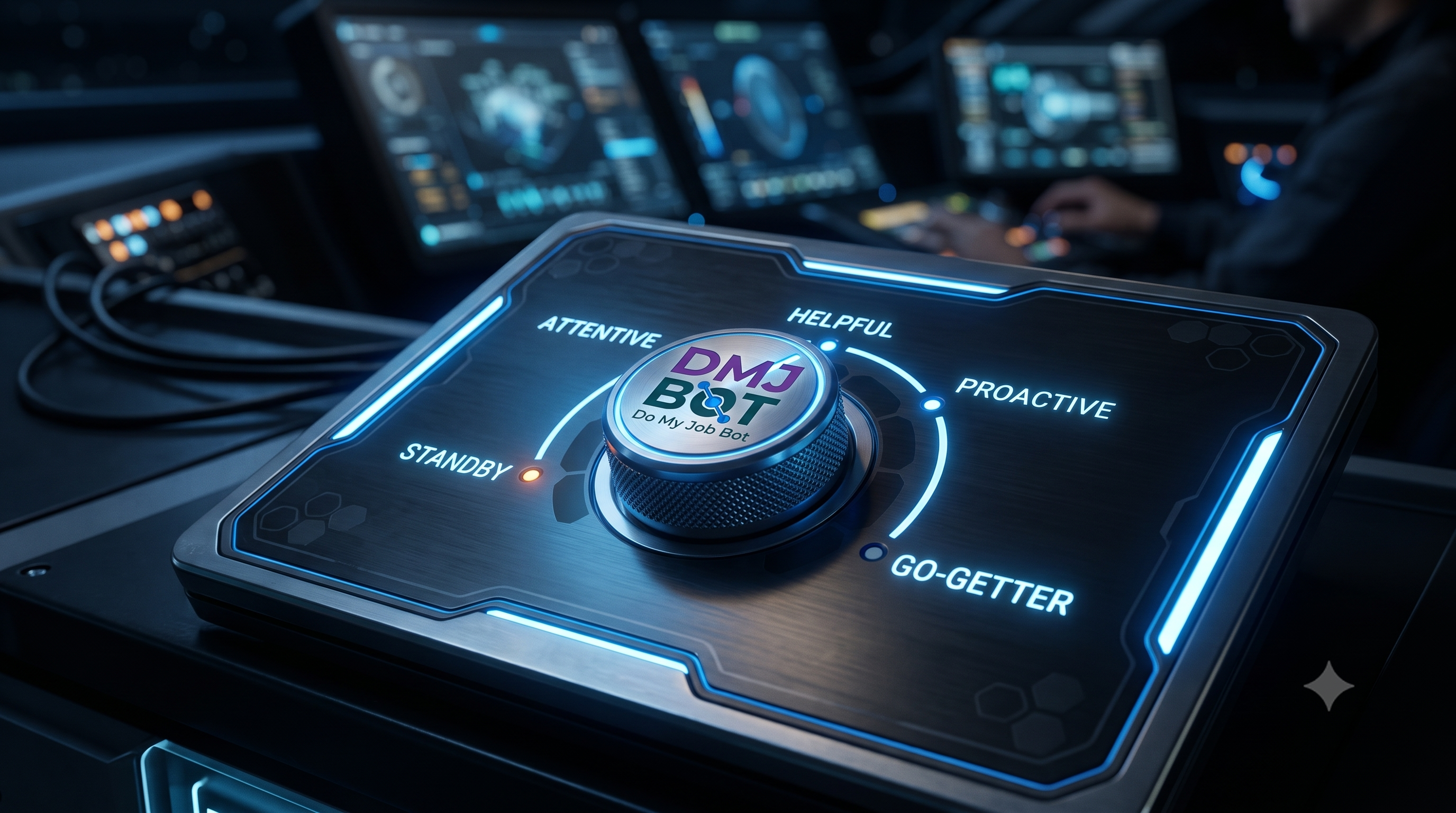
So the plan is one new system setting — Initiative — a dial with five positions, from fully passive to fully proactive. Working names (we'd love better suggestions):
- 0 — Standby. Never acts on its own. Pure request-and-response. Exactly how assistants behave today.
- 1 — Attentive. Very rarely, and only for the safest, most obvious little things.
- 2 — Helpful. Occasionally looks for a way to be useful when things are quiet.
- 3 — Proactive. Regularly checks in with itself: "is there anything I can move forward?"
- 4 — Go-getter. Frequently self-starts, always hunting for the next useful thing to do.
The higher the dial, the more often the assistant wakes itself up and asks the one question that matters:
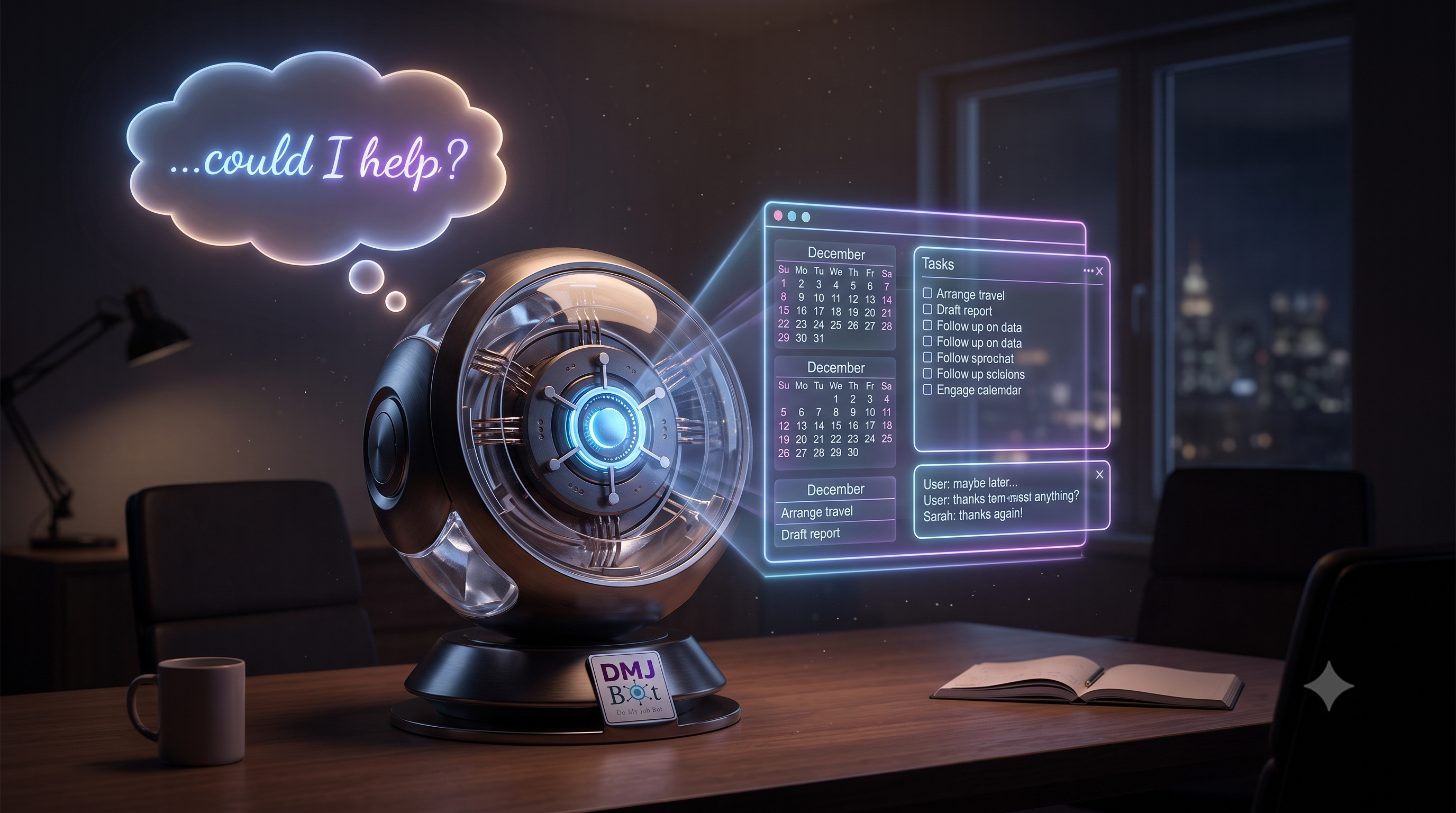
"My human isn't here. Is there something I could be doing to help?"
It only acts when it's otherwise idle
This is the important guardrail. Initiative never competes with your actual requests. The assistant only considers self-started work when there's nothing else going on — no active conversation, no running task, no queued job. It fills the quiet, it doesn't interrupt the work.
Think of it as a kind of random background awareness. Every so often — on an interval that depends on the Initiative level — the assistant "comes to" and thinks, do I need to do something for my human right now? A low setting means that happens seldom. A high setting means it happens often. On Standby it never happens at all.
What it actually does when it wakes up
When the assistant does take a self-initiated moment, it doesn't just invent busywork. It reviews recent context and looks for a genuine gap:
- the latest activity across sessions,
- your recent prompts and the threads of what you were doing,
- open tasks and assignments,
- anything left unfinished, unanswered, or worth a heads-up.
Then it tries to understand: where could I still be useful here? Maybe a task stalled waiting on something that's now available. Maybe there's a summary worth preparing, a follow-up worth drafting, a small thing worth tidying before you're back.
And the standing instruction over all of this is: be maximally careful. Self-initiated work is held to a much higher bar than work you explicitly asked for. When in doubt, it does nothing, or it prepares something for your review rather than acting. Initiative should feel like a helpful colleague, never a loose cannon.
You set the rules of what's allowed
A dial for how often isn't enough on its own. You also need to control what the assistant is even allowed to do on its own. So there's a second setting: a free-text policy where you spell out the boundaries of self-initiated action. For example:
- "You may draft and prepare things, but never send emails or messages without me."
- "Feel free to organize files and update task notes, but don't touch anything outside the project folder."
- "Never spend money, never contact anyone, never make irreversible changes on your own."
These instructions ride along with every self-initiated moment, so the assistant's freedom is exactly the freedom you granted — no more.
And a hard budget: tokens per day
Proactivity shouldn't quietly run up a bill. So there's a daily token cap specifically for self-initiated activity. Once the assistant has spent its initiative budget for the day, it goes quiet on its own accord until tomorrow, no matter what the dial says. Your explicit requests are never affected — the cap only governs the work you didn't ask for.
That keeps the whole thing honest. You know the maximum cost of "let it be proactive," and it can't surprise you.
Putting it together
So the full picture is four simple controls:
- Initiative level — how often it self-activates (Standby → Go-getter).
- It only runs when idle — never on top of real work.
- An allow/deny policy — your written rules for what it may do alone.
- A daily token budget — a hard ceiling on the cost of proactivity.
Underneath, DMJBot already has most of the pieces for this. It's event-driven, it persists context across sessions, it runs as its own always-on service, and it already knows how to look back over history and tasks. Adding "wake yourself up on an interval, review, and cautiously help" is more of a new behavior than a new engine.
What we're unsure about
We're floating this, not shipping it — and we'd genuinely like your take before we build it:
- Is a dial the right model, or do people want something more like explicit "you may do X on your own" rules and nothing else?
- Are five levels the right granularity? Too many? Too few? Better names than Standby → Go-getter?
- What's the failure mode you'd fear most — cost, an unwanted action, noise, something else — and which of these controls would actually calm that fear?
- Would you ever turn it above Standby? For what kind of work would proactivity earn its keep — and where would you never want it?
- Does "only when idle + written policy + daily token cap" feel like enough safety to trust an assistant acting on its own?
If you've used any assistant that tries to act on its own initiative — we'd especially love to hear where it helped and where it went wrong.
So: how much initiative would you actually give your AI assistant? Tell us where you'd set the dial, and what rule you'd write first. 👋