From the series "Applying Psychology to Building AI Harnesses"
I continue to be fascinated by how psychological concepts can inform AI design. In previous posts, I explored forgetting as a useful property of an AI memory system and attention as a way to prioritize work. Another concept that seems surprisingly relevant is perception.
In psychology, perception is the process by which the mind organizes and interprets sensory information into a meaningful understanding of the world.
It is important to distinguish this idea from perception in computer vision or multimodal AI. I am interested in a broader question: how should an AI system perceive the world around it?
The information may come from cameras, microphones, sensors, user interactions, APIs, emails, logs, monitoring systems, or countless other sources. How does the system combine these observations into a coherent understanding of what is actually happening?
Sensation Is Not Perception
Psychology makes an important distinction between sensation and perception.
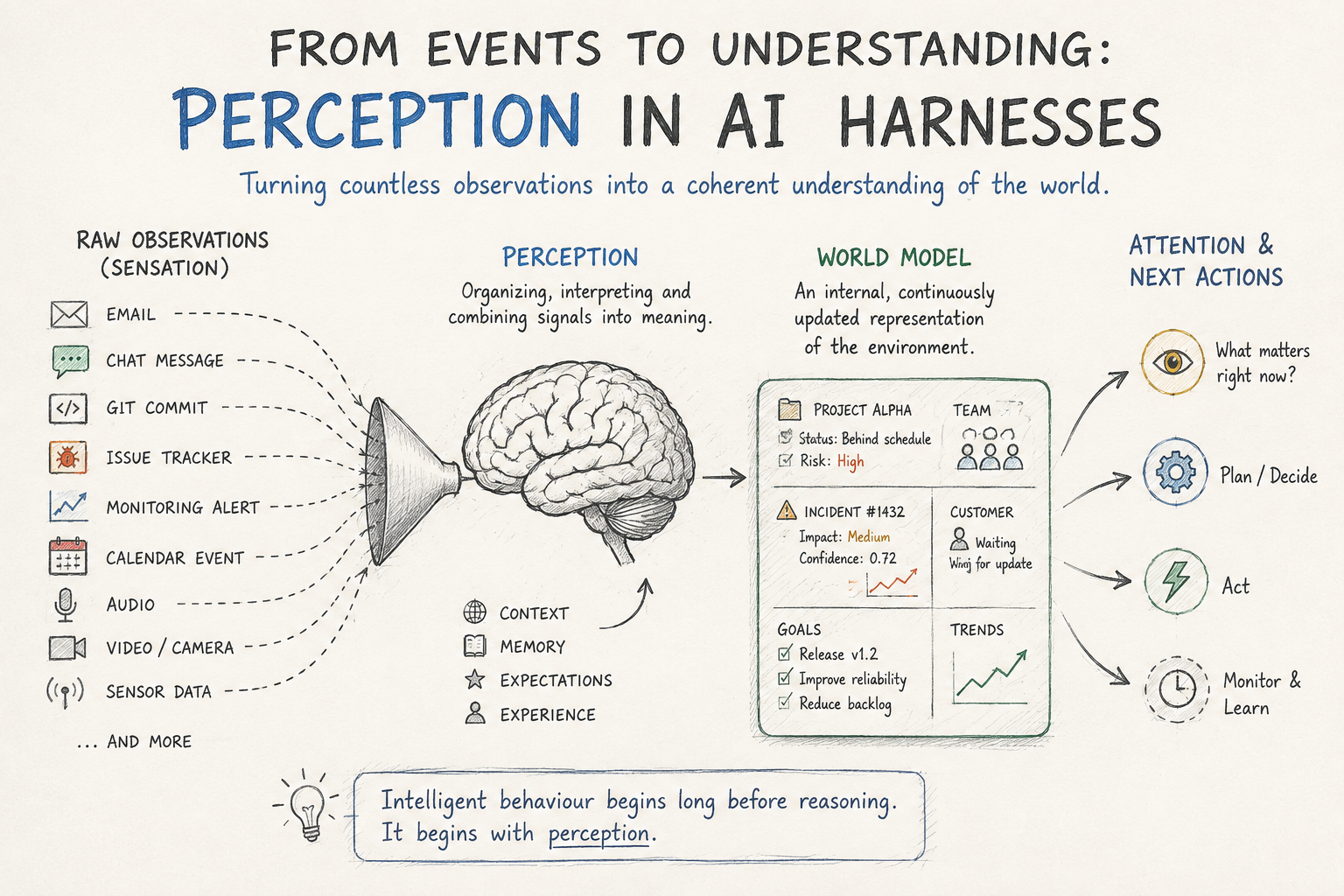
Sensation is the raw information arriving through our senses. Perception is the process of organizing and interpreting those signals into a meaningful understanding of the world. We do not perceive isolated sounds or pixels. We perceive people, conversations, problems, opportunities, and risks.
Many AI systems still operate much closer to sensation than perception. They receive observations and process them one by one. A Slack message, a Git commit, a monitoring alert, or a camera frame are all treated as separate events. But individually, they rarely tell the whole story.
Imagine an engineer opens a pull request, the CI pipeline starts failing, and shortly after that a customer asks for an update. These are three independent observations from three different systems. A perceptive AI harness should recognize a higher-level situation: the release may be blocked.
The Role of a World Model
This is where the idea of a world model becomes useful.
Instead of reacting to isolated events, the AI continuously builds and updates an internal representation of its environment: people, projects, goals, incidents, devices, or anything else relevant to its domain. New observations do not replace the model; they refine it.
Attention, planning, and reasoning can then operate on this evolving understanding rather than on a stream of disconnected events.
Context Changes Meaning
Psychology also reminds us that perception is contextual. The same observation can have very different meanings depending on the situation.
A pull request on a feature branch is routine. The same pull request for a production hotfix on Friday evening may deserve immediate attention. Perception is not about collecting signals. It is about interpreting them within context.
In my earlier article about AI self-consciousness, I suggested that future AI systems may need a continuously evolving internal representation of the world rather than relying only on request-response interactions. Perception can be viewed as one of the mechanisms that creates and maintains that representation.
Why This Matters for AI Harnesses
As we continue developing DMJBot, we keep looking for ideas from psychology that can improve practical AI systems. Perception is another example.
Intelligent behaviour begins long before reasoning. It begins with perception: transforming countless observations into a coherent understanding of the world.