Plans Sign In Register

Audio Input For Your AI Assistant — The Best Way To Catch An Idea

Audio Input For Your AI Assistant — The Best Way To Catch An Idea

When we built the first version of the DMJBot mobile apps, audio input was near the top of the list. Not as a nice extra — as one of the reasons to have a mobile app at all.

The use case we had in mind was very specific:

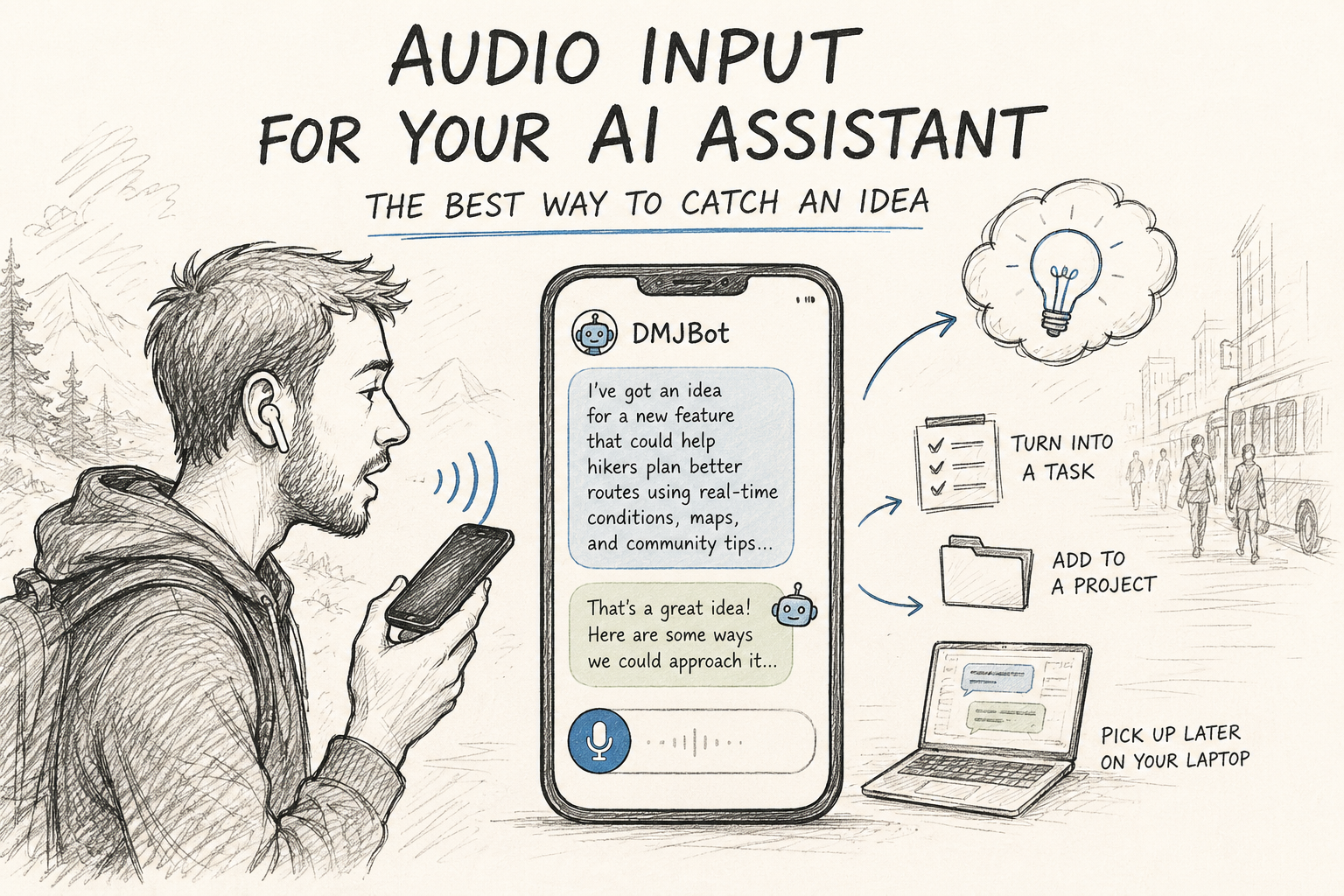
"I'm away from my laptop and an idea hits me. I want to do something with it now — not just store it. I want to think it through, get some pushback, maybe turn it into a task for later. And I want to do all of that from my phone, fast."

Notes apps solve the first half of that. You write the idea down and it waits for you. But an AI assistant can do the other half — react to the idea while it's still warm. The only thing standing in the way is the keyboard. On the go, walking, driving, in a queue, you're not going to type three paragraphs. So we added the microphone.

Continue Reading ...

How North East England and Newcastle Inspire Innovation

How North East England and Newcastle Inspire Innovation

Some places do not just host innovation. They shape how it happens.

People often talk about innovation as if it only belongs to a few obvious places. London. San Francisco. Berlin. Somewhere with a polished pitch deck, a rooftop office, and a permanent camera crew filming founders drinking coffee.

That has never felt true to us.

We live and work in the North East of England, and the more time we spend building AI systems and autonomous agents here, the more it feels like one of the most natural places in the world to turn ideas into reality.

Continue Reading ...

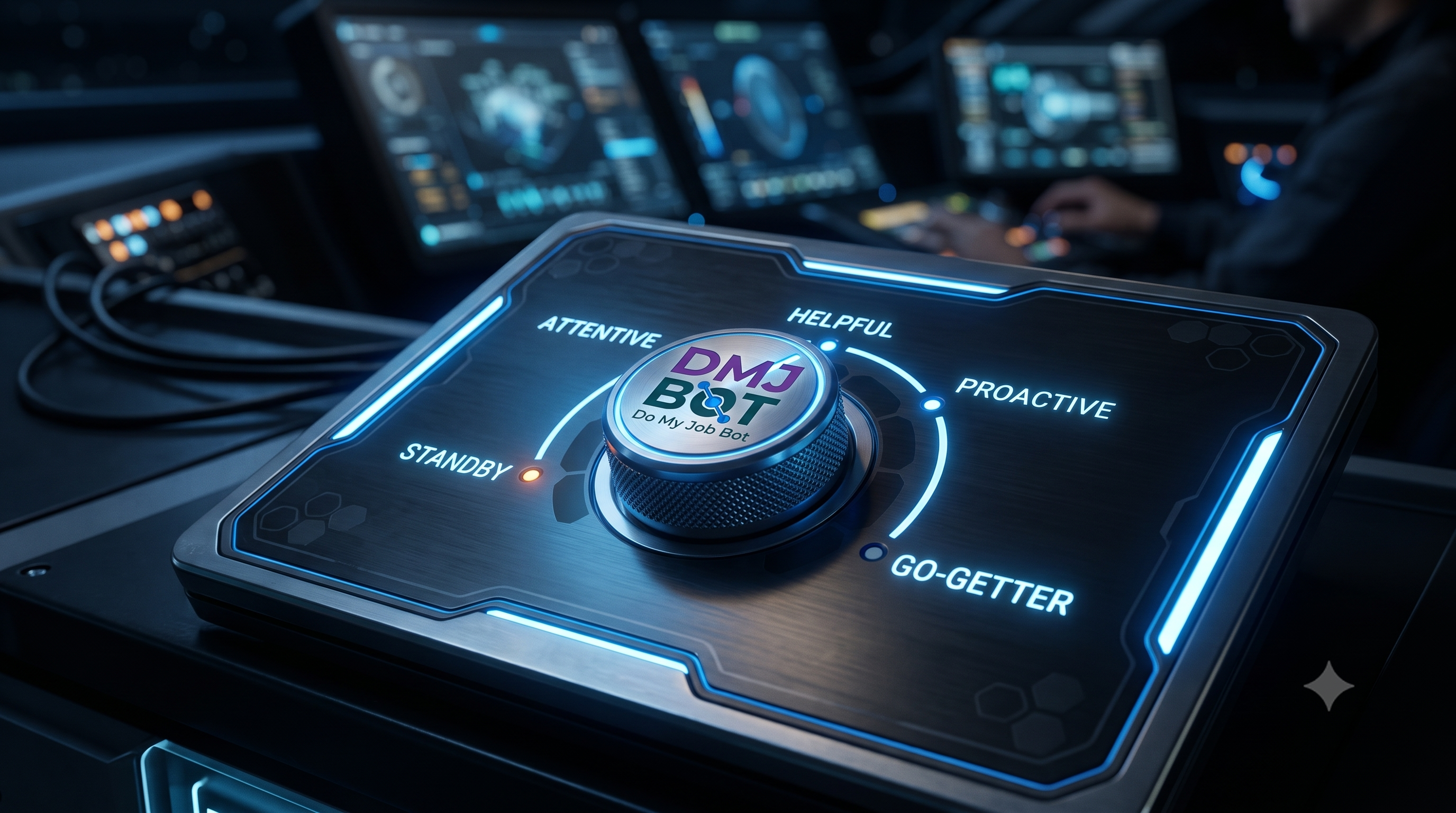
How Much Initiative Should Your AI Assistant Have? A Dial From Wait for Me to Go for It

How Much Initiative Should Your AI Assistant Have? A Dial From Wait for Me to Go for It

Our team has been kicking around a new feature for DMJBot, and one question sits right at the center of it:

Should an AI assistant have a configurable level of initiative?

Could the assistant do something on its own — while you're not around — and could you turn that up or down? Make it very active, or barely active, or shut off all self-started actions entirely?

We think this could be genuinely useful, so before we start building it we want to describe it here and get feedback from the community. Here's what we have in mind.

Continue Reading ...

Automating my Reddit routine with AI and a web browser

Automating my Reddit routine with AI and a web browser

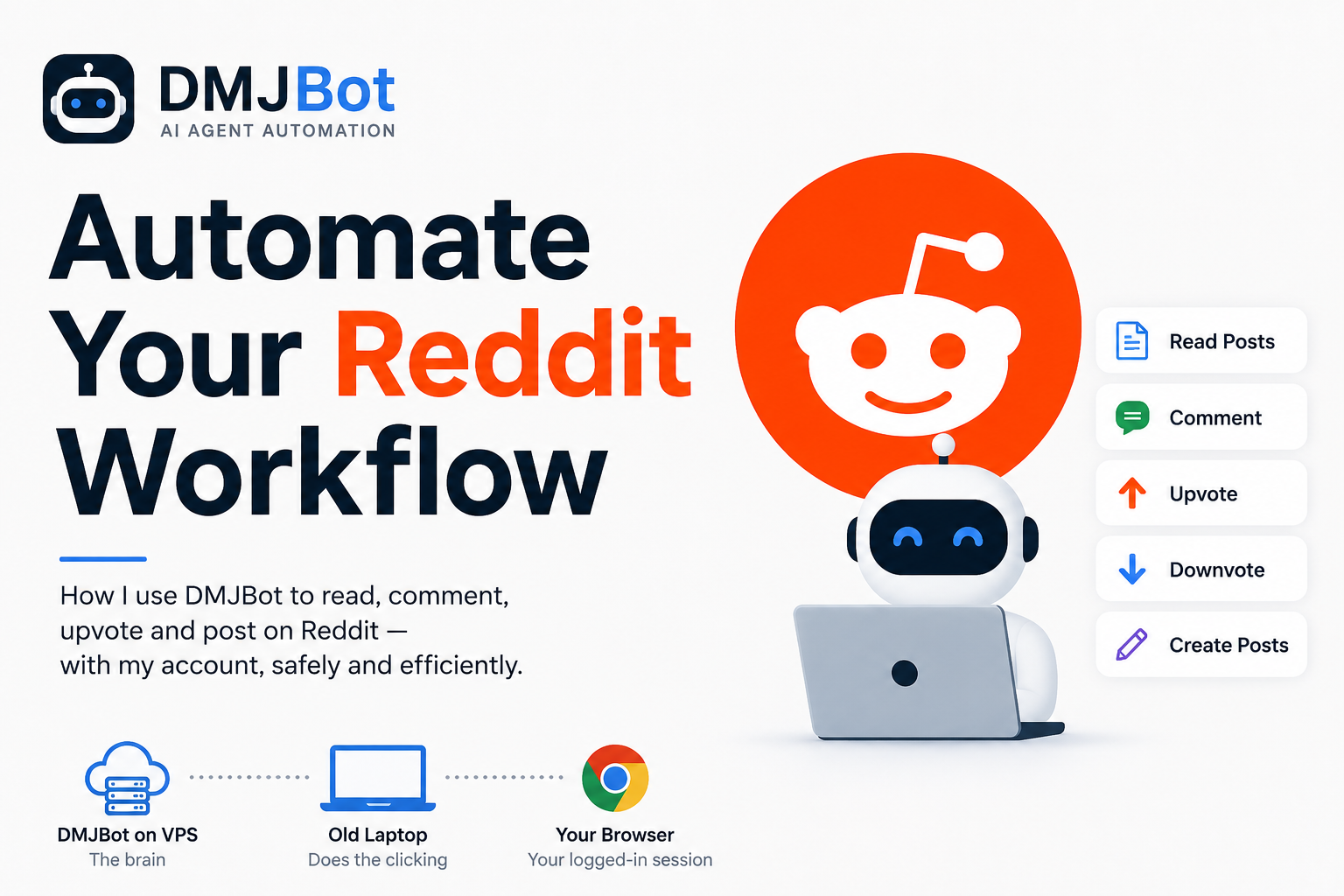
I would like to share my experience of using DMJBot to automate my daily activities on Reddit.

This is not about spam. I just wanted to save some time on the routine stuff I do anyway. Usually I open a few of my favorite subreddits, read some posts, comment on them, upvote or downvote, and occasionally publish something myself. I use only my own account for this — no multiple accounts, no spam, no bot farm. Just me, doing the same clicks I always do, except now I don't have to.

So when I got DMJBot running, Reddit was the first thing I decided to hand over to it.

My setup

I run DMJBot in Docker on my VPS.

I also connected all my laptops to it, including two old ones I hadn't touched in a long time. Both just sit with closed lids in my utility room, plugged in and connected to my DMJBot instance. One of them runs Windows, and that's the one I use for Reddit automation.

On that laptop I installed the dmjbot-bridge tool and a Chrome browser, and gave DMJBot a way to drive Chrome on it. Before automating anything, I logged into my Reddit account in that browser by hand and confirmed everything worked. From then on, DMJBot uses that browser session — the same logged-in Chrome I would use myself.

For the AI side I mostly use DeepSeek models, but I have all the top models configured too (OpenAI, Google Gemini, Anthropic, and others) and switch between them when I feel like it.

Continue Reading ...

Your AI Dev Team Needs a Manager. DMJBot Is Built for That.

Your AI Dev Team Needs a Manager. DMJBot Is Built for That.

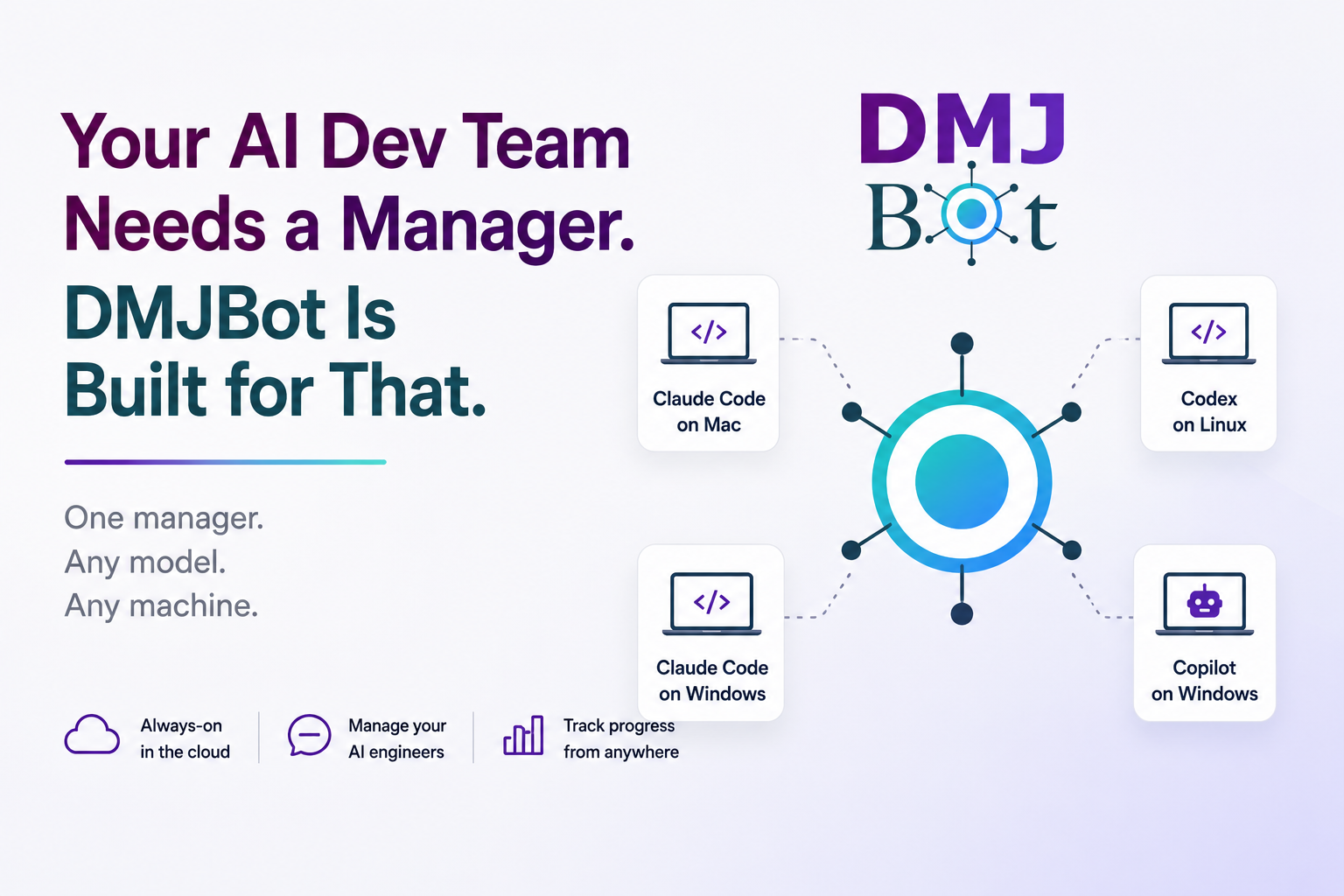
Many developers are already running multiple AI agents and assistants across multiple machines.

A common setup looks like this:

  • Claude Code on a Mac for one repository
  • Claude Code plus Copilot on another repository
  • Codex on a Linux server for automation-heavy work
  • Another Claude Code account and Codex instance on a Windows machine

You can absolutely make this work. But after a few days, the real bottleneck appears: management overhead.

You become the human message bus.

You switch between remote desktops, terminals, and chat windows. You repeat instructions. You manually track what was started, what is blocked, and what actually finished.

In other words, you built an AI engineering team, but you still do the project manager job by hand.

Continue Reading ...

How DMJBot Is Different From OpenClaw

How DMJBot Is Different From OpenClaw

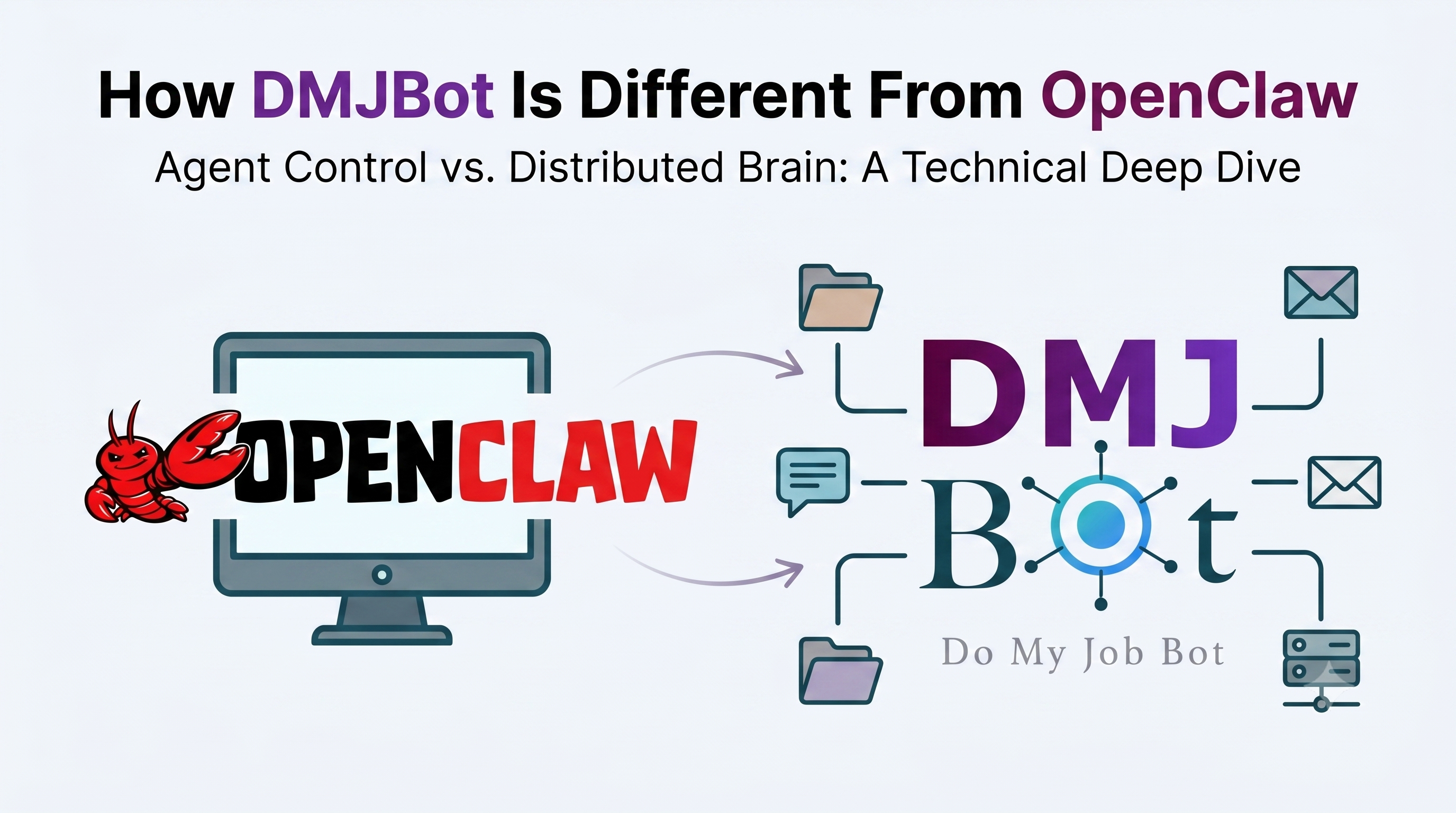
People sometimes ask how DMJBot compares to OpenClaw. It's a fair question — the goals look similar. But the two tools were built independently, and under the hood they could hardly be more different.

First, a clarification: DMJBot is not based on OpenClaw. We started building it before OpenClaw was released. We arrived at a similar ambition — an AI assistant that actually does your work — but the implementation is entirely our own.

Here are the two differences that matter most.

1. We don't take over your computer

OpenClaw's model is to own a whole machine. It needs a full computer, it controls it, and it does everything there.

DMJBot takes the opposite approach. The only thing that runs is the brain, inside a Docker container. System requirements are minimal — it's just the orchestrator, not a desktop it has to occupy.

From there, you connect devices to it — one or many — and you decide how much each one shares:

  • full control of a device, if you want that, or
Continue Reading ...